Choose your own adventure

During the 80’s and 90’s existed a serial of books that allowed the reader to choose how to live the adventure, by deciding what path to take. Each of them had around 30 possible different endings.

Before the pandemic, we knew how to handle our day to day, and from time to time we could pick up something different, just to give it a try, living a secure experience.

But, COVID, turned upside down our life, transforming it into kind of a “choose your own adventure”. The difference here, is that there were no written possibilities, no written rules. No one told us the way we should deal with the lockdown, how to handle our social relationships also when back to normality and for sure, no one was able to give a guideline on how to go back to ”I know what comes next”.

Any tiny reminder of our previous us, is fine, why not watch again that movie? Change or repeat the small things that are under our control. Build our new, owned ”normal”.

Learning along the way

Book + Training + Practice this is how some of us have learnt to learn. But life does not come with a manual, there is no book to check on, no teacher, no trial and error process and we can only do our best. Not being sure if the answer it is correct, doesn’t mean it’s wrong. Not having the perfect solution doesn’t mean we have failed.

We should not put on hold trying neither not punish ourselves if it did not go the way we imagined the first time. There will be more. We just need to try again, harder, more focused and aware of what worked and what did not.

Just do not push anything away just because you need to learn the perfect way first, it might be too late or you will might have to rush and it will not be even good enough to go.

The world has changed, so if we want to continue learning from it, we need to look at it through a different glass. Stop watching is not the answer. Still, keep it simple. Always.

Staring at it won’t make it go away

This morning on my weekly running, I came across a girl who was staring at her bike. Apparently she was having a hard time with its chains.

On my way back, she was still in the same position, staring, same angle, same look on her face and not trying anything ay all…

We can get stuck when trying to solve a problem and stare at it for a while. After that, we need to change our visual angle, try at least something (even if it might not work), or ask for help. Probably, there will be someone who knows how it can be fixed, have different approach or at least a slight idea of where to start from.

Staring at something for ages, not even changing the way we are trying to solve it, will not make it solve by itself, will not disappear. Magic does not exist it is made to happen.

A million things


A million plans ahead, a million words you would like to say or have said, 1,000,000 moments you would like to spend among friends and/or family, books to read, conversations to have, projects to start, ideas to develop, places to visit, adventures to live, minutes needed to reset, kisses and hugs to be given, …

I ”should” is a multiplier towards incomplete lives. Do not let time just go by. Remove it from your day to day, start small, one thing at a time. Enjoy it, try it, do your best, maybe it won’t excel but you will have tried.

Put one million attempts behind (Achieved or not), lead the things you want to happen. Be grateful with those who love you and you love, as they probably made the first move when you couldn’t.

There were one million topics I wanted to write about, but I felt it would be nice to close the summer with this.

Thanks for new old moments, for keeping it simple, for coming along.

We do not have a problem

When you continuously challenge yourself, your environment, how things are done, how does the world work, .. You probably see fixable stuff everywhere.

Organizations are made by people, their knowledge, skills and attitude. The oriented-to-change or to improvement organizations&teams are always looking around, searching for things to be fixed, anything that can be improved by doing differently. Processed that are obsolete and needs to be adapted to a new reality or even better, to be created as there is nothing that can cover the gap. They act proactively. They always see an opportunity, a puzzle / problem that can be solved. The usual answer to How are thing going will be: we could do better.

The oriented-to-resolve organizations&teams happen to be on the other side of the room. They look only to fix what’s broken, only taking action when a PROBLEM is on the table. And when it does, when the problem is visible, it’s usually because it has become important, big, visible. It’s the outcome of adding many issues to which we didn’t pay much attention to, they were too small to be considered. The usual answer to How are things going? Will be: we don’t have any problem.

Well, continuous improvement permits us to avoid big problems or difficulties and be ready for the next challenge. And this is mainly a matter of attitude. The tools for changing will come after.

Because, if we don’t have a problem…. we have a problem.

What was highlighted by others before you did

You have been asked to read and summarize a document. And someone else was asked to do so before you. That person highlighted what he/she considered were important parts or remarkable ideas.

  • Should you just replicate what was done and make your someone else’s words?
  • Should it be a guideline, to develop your own thoughts and comments from where they left it? Enrich someone else’s ideas?
  • Or, should you make a double effort, ignore the tentation of effort avoidance, start from “non real” scratch and build your own summary and conclusions?

Decision-making can sometimes be like a document overview. You can just repeat what someone else decided was important (keep things like they were), you can enhance someone else’s choices or you just can take it as another piece of information and make your own choices. It all depends on how much do you want to see reality with your own eyes (maybe you will reach the same conclusions as others did), it depends on how much do you want to contribute with your own vision of the world and reality. It’s always up to us.

Wolf, sheep and cabbage game

There is this mind game. There is a farmer that visits a market and buys a wolf, a sheep and a cabbage. On his way back home, he needs to cross a river. On the boat he can only carry himself one of them to the far bank of the river, so here is the thing. How will he make it? f left unattended together, the wolf would eat the goat, or the goat would eat the cabbage.

Sometimes we feel like facing unsolvable issues. But is nothing else than a matter of time and patience. We have tones of problems, tricky decisions, … we lack of patience and time to dedicate to them.

Well, in the end some things can only turn into a mind game. Find the time, let patience help you.

The business case

When facing decisions, or changes we can look only at the cost / benefit piece. That of course, will bring useful figures but it is not always about making the numbers.

Qualitative data is as important as economics. What can you get from the new software, how would it bring the team to the next level, will it make it easier for everyone to manage the day to day? Are we talking about a new location which is closer to most of the employees location?

Are you reducing lead times? Reducing mistakes? Gaining peace of mind?

There is a lot behind one meditated decision. Or it should be.

Long term investment vs short term results

Seems that the short term means more pressure than the long term plan but id does not.

We can usually find ourselves surrounded by who is willing to bet only in the short terms efforts and results. Who is always living in the urgency, demanding a new, additional effort. Than can be one time thing, or something demanded by the situation. When it becomes the normal for those people is usually due to selfish reasons. Trust misuse, ignoring others advice and expertise, sending urgent emails, short term results that would need long term planning.

And it can add more pressure if you are a long term person that invests and is not a one time consumer.

In the case of long term view, there are much more opportunities to become and to build something bigger. It requires more focus.

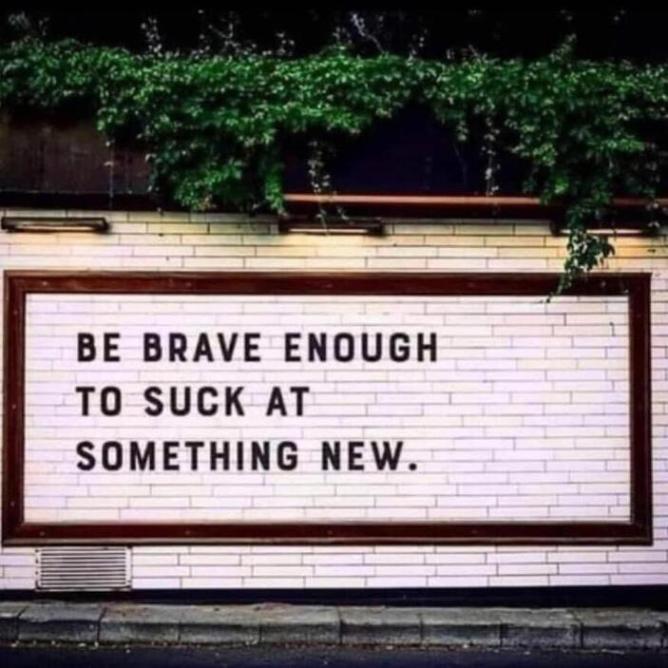
Being brave to suck at something

It would be rare that you’d never heard of, never been told about the comfort zone. How we should always try to expand it, by moving one step away from it progressively.

Is always scary to stop doing what you master to experiment. So it’s easier to agree to developing by trying something new but familiar. Remember, one step away at a time.

There are times when you just need to take a run-up to jump as far as you can, so far to get away, away to un unexpected zone. Well, when you already excel at something is not easy to start from scratch knowing that you might suck at it at the beginning.

This if fear keeps behind people, the fear Of not being the best the very first day, to not know everything. Over and over we repeat, surround yourself by braves, or be the hero or patient zero. Help others grow, be on their side during the trip.

Your choice.

Thanks Matthew Daniel for the picture!