Vertigo

It can be described as the feeling or sensation that the body is spinning or that objects are spinning around it.

And kind of something similar is what we feel when we face (out of the blue) the unknown, when there is a no written path or rules to follow. So then, you hope you can find at least someone or something to hold on to so you can feel secure.

Sudden changes, moving away of what you control and enjoy can be scary. Listening, watching how people acts and what is going on around you, helps. And if you mix it with what your inner self tells you, everything gets better. And then, the spinning slows down, the vertigo turns into something different, a bit of nervousness as you feel the thrill, the challenge and the growth right in front of you.

The business case

When facing decisions, or changes we can look only at the cost / benefit piece. That of course, will bring useful figures but it is not always about making the numbers.

Qualitative data is as important as economics. What can you get from the new software, how would it bring the team to the next level, will it make it easier for everyone to manage the day to day? Are we talking about a new location which is closer to most of the employees location?

Are you reducing lead times? Reducing mistakes? Gaining peace of mind?

There is a lot behind one meditated decision. Or it should be.

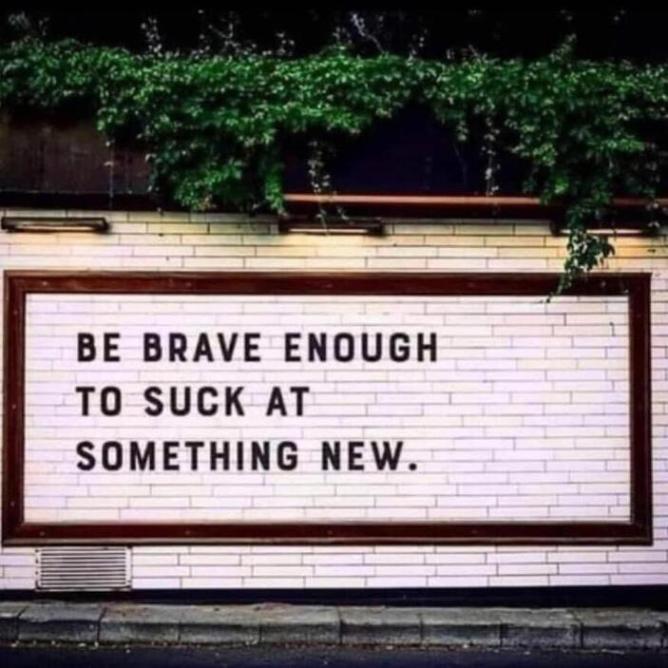
Being brave to suck at something

It would be rare that you’d never heard of, never been told about the comfort zone. How we should always try to expand it, by moving one step away from it progressively.

Is always scary to stop doing what you master to experiment. So it’s easier to agree to developing by trying something new but familiar. Remember, one step away at a time.

There are times when you just need to take a run-up to jump as far as you can, so far to get away, away to un unexpected zone. Well, when you already excel at something is not easy to start from scratch knowing that you might suck at it at the beginning.

This if fear keeps behind people, the fear Of not being the best the very first day, to not know everything. Over and over we repeat, surround yourself by braves, or be the hero or patient zero. Help others grow, be on their side during the trip.

Your choice.

Thanks Matthew Daniel for the picture!

What when the idea isn’t as good as we thought?

We are by nature ideas-generating machines. In a day we can ask and answer to ourselves so many times.. What if I did, try? And could I go home using a different route? Why don’t we? Hummm… what would happen if…?

As easy as they flow in our minds wwe let them go when we do not put them into practice.

From time to time, we have THE idea, and we decide to turn the picture we draw in our minds into something real, tangible. We start drawing how it will look like, to think of what we need, key milestones, resources, … Step after step. We give our time, effort, enthusiasm, hope, … All along this journey we are learning, upskilling, evolving. But we don’t realise we are.

Then, we achieve what we thought was our destination, our goal. And after a time of happiness and calm, discomfort shows up, we don’t get the results we expected. We realise it is not working. After all the excellent work, it’s not useful, it’s not the game changer we believed would be.

Nobody likes to be wrong, and so we insist, pushing forward, denying the obvious. To continue in the wrong road is exhausting and frustrating.

Admitting failure is brave. As it is to start again from scratch and to get advice from friends&experts.

Failure is not nice. Denial is fatal.

Yeah, we fail but we learn from it and move on. Better.

Give me the space and the sky will be my limit

I ‘ve heard that there are creative and logical people.  But both have in common that when allowed to build something new, they come up with brilliant ideas. Ideas that, maybe, for years they have been thinking about but no one could hear them, that were triggered by a comment during an informal conversation, that ….

Want new things? Want to transform your team? Try opening a window, just to get some fresh air, letting people speak up, allowing ideas to flow freely, soon what they will open is a door.

Don’t let any judgment call come in, leave the group develop by itself, build from an old idea. Who knows? Anything can happen. The most tiny, microscopic idea can grow exponentially in a very short period of time.

Give them the tools to include news ways of doing, of thinking. The rest will come up by itself.

Logical or creative, we all have a lot to say, and when we are willing to change and develop, we are given the space to do so, the confidence, the freedom we encounter the «best of us».

Let them build their own future.

About books, summer assignments and teams

Photo by João Silas on Unsplash

Think back to those school days, (no need to say how many), when being kids, we were asked to do different assignments during summer time. One of them could be to read one or two books, elaborate a summary, answer a list of questions and give our opinion about what was the author trying to tell us. We were «responsible» for completing the task. The teacher was «accountable».

We are not in school anymore, but some principles remain the same although the comparision with organizations can be a bit exaggerated.

In modern organizations every person on a team may be responsible for a given task that is required to complete a massive project. Back to school, You are the one to read the book, write a summary of it and answer the teacher’ questions if the moment comes. You can do what you were asked, ignore the assignment hoping that no one will ever ask, or roll the dice by copying from someone…

But leaders, they need to hold themselves accountables for the results. Accountability «is defined as taking ownership to ensure responsibilities are achieved as expected. This means that leaders must clearly understand expectations before making commitments.»  So, as leaders, we are our «team’ teacher». Teachers know the result they can expect, what they want to achieve when having their students doing something, reading, playing, creating. They know each student potential and their limits. They will take ownership for the class lack of performance, they will know how to reward and how to correct. So being a leader means that we can not be the ones asking what was the book about  because the principal shows interest. As leaders, we have responsibilities: to know what kind of book we are asking to read, to prepare them for the future, to track our class progress and provide assistance if needed.

We are not in school anymore. But we still have a lot to read.

resonsilibity and accountability in leadership (Eagle’s flight)

Giver or taker, which one are you?

In the previous post Explanations, motives and timing. Actions talk about us, we took a look at the «Why, When and How»  that defines our truly personality. In today’s post I would like to elaborate a bit more on the Why, on its impact on us and what surrounds us (colleagues, organizations, society). As an essential ingredient of that «The Why» we see two different kinds of people:

Takers: Who are self-servers in there interactions: What can you do for me?

Givers: Most of their actions are based on a What can I do for you?

So, givers, they take the worst part in the P2P business of interaction between givers and takers. They put a lot of effort. They spend a lot of time trying to improve the team at a high cost for them. Bad for them, good for their organization. They are the key stone for team building, for collaboration and great motivators. But, be careful and remember that they need to be handled with care mainly when they are surrounded by Takers, because we can lose them. They can get frustrated.

We dedicate a lot of time and energy to our organization, there is a lot of us on their success or failure, on the speed of change, … And because we never leave a 100% our personal life out of the workplace neither who we are (behavior=our moral compass + our mood + background + a response to others actions + many other things) we can not afford loosing givers on the way.

Adam talks about 3 possible ways that will create a «net» of successful givers:

  1. Protect them from burnout
  2. Encourage help-seeking
  3. Keep the wrong people off the bus

I highly recommend you watching this TED Talk by Adam Grant, enjoy it.


Weaving your network. Weaving your web.

When we talk about » our network», we usually think about it from a professional perspective only. But it is far more than that, it is a personal web formed with family, friends and occasional contacts not directly related with our profession or daily activity.

The network we have created is part of a greater thing, part of a Web, a “personal spider web”.

Built during years through different phases, in the earlier steps of creation, the family ties. Then, kinder garden, school, college friends. And finally those who we meet during our professional life. There is an invisible line that connects us with each of them.

 Our webs can be classified into two types:

  • Concentrated:

Tight&Strong links with and between the different constituents. We care about each of them (of course in different ways…). Its configured by those who inspire us, who teach us, … We dedicate to them time, to connect, to listen, we then, strengthen the link. Being at the center of this cobweb means that if we jump we will gain momentum, in case of troubles we will find help. As per its structure our web can do the same for others.

  • Dispersed:

 Widespread web, weak tights. We can care but we can’t dedicate enough time or just care about the number of constituents, no matter what. If we do not take care of each thread, if we don’t check out and fix when a problem arises, the quality declines. And finally, it can break.

 A concentrated web is more effective, from a professional and personal perspective. We should pay attention to what matters, and take care of it. Ensure that the invisible line is strong. By that, any time that the other’s web grows ours will do so.

 Every time we meet someone, we have the opportunity to include him in our network.

The «W.A.I.T.» principle for better meetings

Meetings, meetings and more meetings. We have plenty of them in our agendas, scheduled, improvised, well planned, .. How many of them have we left with the thought that nothing was decided, that the important stuff was not said, or that everyone had to say something no matter what? Unproductive meetings take place pretty often.

Want to make the most of YOUR time? Let’s look at one of the biggest time-consuming activity: MEETINGS! You will be gaining time, respect and freedom.

When you are one of the attendees you need to be prepared. Ask for the agenda and documentation in advance (so you can know what to expect). During the meeting, use the W.A.I.T principle, Why Am I Talking? Do I have a point to make? Is someone asking for my opinion on something? Will, what I say, add any value to the ongoing discussion? If yes, then be concise. Think before you speak, consider what others said and what you want to obtain from your speech.

Did someone say something that bothered you? Are you going to speak just to correct someone else’s mistake? Is that correction critical? Would make any harm if you ignore it? Are you just speaking to fill in a silence? If your answer was yes, then, do not talk. There is no need to. Do not panic if you do not say a word during the session.  Next time, make sure you participate only if it’s  important for you to do so. It will help you in many ways, one is that you that sense of wasting time will reduce and at the same time it will free you for productive, creative work. Space to think and create. Sometimes we feel… lost, idle if we do not have a busy agenda, or if we do not say a word during a session… It is not real, you are no more important than others by having no free slot or talking more than anyone else. You are as important as your valuable opinion. When you speak up at the right time.

Why Am  I talking - productive meetings

The diagram refers to meetings but it is applicable to one to one conversations, professional or personal (follow the left side of the diagram). Say what you need, do not over-talk, find the right moment.

Ready to be more efficient?

Thanks to Work Compass (http://workcompass.com/blog/)