T / L Ratio

“If we were supposed to talk more than to listen, we would have two tongues and one ear” Mark Twain

If we learn by observing, by copying someone else’s movements, learning by listening is a great option. In listening we can learn many important things. But that it’s not what usually happens.

We tend to talk al lot, and we “hear” what is being said, usually just awaiting the moment our speaker has finished so we can start our own speech. And that is mainly because from very young we are taught on how to talk, how to express ourselves, how to get the audience’s attention. So, our Talk / Listening ratio usually becomes >1. And that is no good, not helpful.

So, what to do to change the situation? Any knowledge, any different behavior we acquire in our adulthood takes a considerable amount of time and effort as we need to alter our habits. Truly listening would be on the “difficult ones” list. Turning around the ratio, Talk/Listening<1 will require your full attention 😉

Some tips:

  • “be patient my friend”, practice makes perfect and if you want to be a good listener you need to wait (allow your speaker finish completely prior to saying anything)
  • Play mindfulness, yes, stay open-minded, avoid assumptions, do not let yourself be led by stray thoughts, stay focused on listening
  • Create an open space: remove any obstacle, be careful with your body language, ..
  • be organized, if you don’t have the best brain storage capacity, take notes
  • PRACTICE, practice, practice

We are back, in the middle of August, but is there anything “business as usual” this year?
We do not have a problem

When you continuously challenge yourself, your environment, how things are done, how does the world work, .. You probably see fixable stuff everywhere.

Organizations are made by people, their knowledge, skills and attitude. The oriented-to-change or to improvement organizations&teams are always looking around, searching for things to be fixed, anything that can be improved by doing differently. Processed that are obsolete and needs to be adapted to a new reality or even better, to be created as there is nothing that can cover the gap. They act proactively. They always see an opportunity, a puzzle / problem that can be solved. The usual answer to How are thing going will be: we could do better.

The oriented-to-resolve organizations&teams happen to be on the other side of the room. They look only to fix what’s broken, only taking action when a PROBLEM is on the table. And when it does, when the problem is visible, it’s usually because it has become important, big, visible. It’s the outcome of adding many issues to which we didn’t pay much attention to, they were too small to be considered. The usual answer to How are things going? Will be: we don’t have any problem.

Well, continuous improvement permits us to avoid big problems or difficulties and be ready for the next challenge. And this is mainly a matter of attitude. The tools for changing will come after.

Because, if we don’t have a problem…. we have a problem.

Don’t get too comfy

You got comfy because you had performed that task a thousand times. You are an expert. If business keeps as usual, nothing could go wrong. Sure? Maybe you could stop paying attention to details, boredom leading to no longer caring about giving a 100%, taking things for granted and focus not being where it should be. Lots of possibilities to make mistakes, wrong calls.

Or it could be that you are used to that comfort that training before practicing brings to our soul. The known path already walked by others is explained to you. The only thing needed here is to learn, apply your background knowledge to find the improvement opportunities and put them in place once you have learned how to handle the day to day.

Or what if, in business as usual you could always trust your guts like surfing the waves of a familiar sea. The one you love, the one you are used to and in which you know when you can get creative and when you can not. Where you can read in the environment.

Or, you know that family and friends are just around the corner and although you love spending time with them sometimes you just want to go home, get comfy in your sofa and have a drink or relax after a hard, long day. In the end, they will always be there.

But, things never stay as we want them to stay, sometimes it’s progressive, sometimes the world is turned upside down overnight. We need to be ready for change, always. Be sure of what we do or think but leaving a tiny space for questions, hesitations. Be sure that nothing is written on stone and maybe you will learn the hard way, by doing.

The only thing for sure, is that every opportunity counts, to be with yourself, to be together with your friends, your family, to learn something new, to go for that extra mile, …

Don’t wait too much for the perfect wave, to enjoy each moment and minute, to get the best from yourself. To think different. To change. Do not get too comfy, everything could just change overnight and catch you off guard.

I am aware of my comfort zones, the topics I love to read and write about. So, will do my best to replan my route, to enlarge my horizon. Thank you for helping me to achieve it.

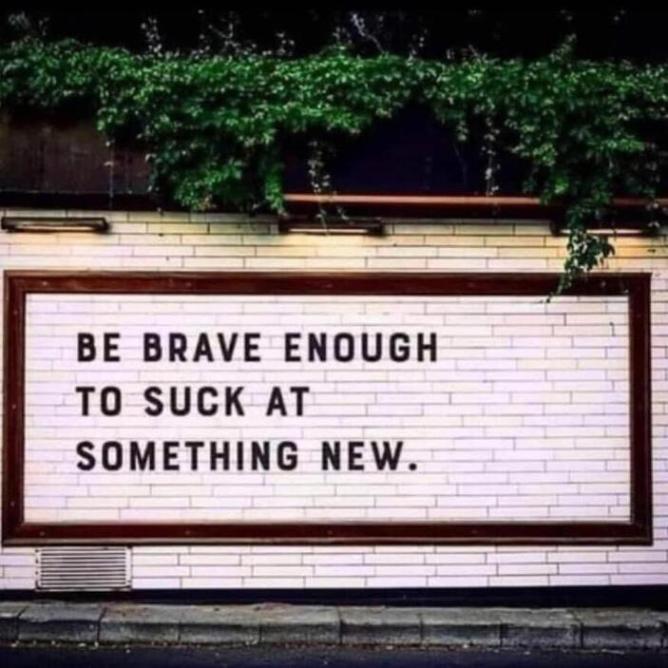
Being brave to suck at something

It would be rare that you’d never heard of, never been told about the comfort zone. How we should always try to expand it, by moving one step away from it progressively.

Is always scary to stop doing what you master to experiment. So it’s easier to agree to developing by trying something new but familiar. Remember, one step away at a time.

There are times when you just need to take a run-up to jump as far as you can, so far to get away, away to un unexpected zone. Well, when you already excel at something is not easy to start from scratch knowing that you might suck at it at the beginning.

This if fear keeps behind people, the fear Of not being the best the very first day, to not know everything. Over and over we repeat, surround yourself by braves, or be the hero or patient zero. Help others grow, be on their side during the trip.

Your choice.

Thanks Matthew Daniel for the picture!

The Pike Syndrome

A classic experiment was first conducted in 1873 by a German zoologist who put a large pike in a tank of water and fed the pike small bait fish. After awhile, he divided the tank by inserting a heavy glass in it. Then, he dropped the small fish into the section separated from the pike by the glass.

The pike charged the little fish. It charged over and over, and each time the pike charged into the fish to eat them, it crashed into the glass. After a number of attempts, the pike gave up and no longer tried.

When the glass was finally removed, the pike and its prey (the little fish) peacefully shared the tank. The pike had learned that pursuing the small fish caused headaches.

Are we any different from the pike? No, we are not. When we let past and painful experiences hold us back from trying something new, we are suffering from the Pike Syndrome. We show fearful behavior based on assumptions that are no longer true. We are then limited by self-limiting beliefs, by what we were been told over and over, …. By many things that might no longer be valid.

That is why we need to try, because we don’t know if the glass is no longer there. We need to revisit our fears and limitations and see if what we were told, what we experienced is still out there.

The last one standing

–  You were not the first to finish the exam, neither the first to begin writing.

– While the rest of the students talked about the solution to the exercise and all agreed that the answer was 23, you could only think about that your calculation result had been 1,908.

– You were not the one always with a question for the teacher in class.

– You are not always the one saying something at a meeting.

– You can not agree on everything your boss says.

– While everyone is moving, changing their role, you are the one staying, same job, same place. You are the «last».

– While everyone seems to get a sonorous reward, you seem to have been given the toughest task

– While everyone agrees that A is the right and unique choice you think that B could work

And here we are…

….. You weren’t wrong then (well, not always) when you thought that the different, sinous path looked worthy, you aren’t wrong now (well, not always).

Not being the first, not matching the majority doesn’t mean you are wrong. It’s only a different way of thinking, timing and approach. And, that feeling of solitude (facing the «mass-correct-ion») fades away, sooner or later. When, something happens that tells you: you were right not rushing, believing in your rationale. But, it requires patience.


Network talks: the impact on labor

In the era of the network society job and employment have experienced a huge transformation.

On one hand, we observe a higher level of individualization, terms as skills, engagement, ownership of your career / development have gained importance over the background. Now, it’s the person as a single element who decides and creates its own path. In a dynamic environment you need to make a difference and/or demonstrate your value constantly. More autonomy, more flexibility, a more demanding environment.

But it doesn’t come alone. On the other hand, labour market by means of different types of contracts (Self-employed, temporary, part time, …) has more flexibility to perform any need of «adjustment».

So, if we add both of them and us the mix over the employees, the result will be two different categories where to fit in:

– «Rebrand-able«, equiped with the skill of recycling themselves, to adapt and change steadily to new technologies, tasks, .. capable of continuous learning, to process information, to transform it into something new.

Generic. Uncapable of keeping the path of continuously learning, whose tasks compete with cheap labour or machines. He/she is easily exchangable.


So now, it’s not only about curiosity, it’s about ensuring you are not left out. Always ready, but even more when what surrounds us changes as fast as in a blink of the eye.

Networks are an interesting element to be studied.

Clueless? Don’t panic

When a problem arises, there are two different type of responses. One is to try finding the answer on what we know or did in the past that apparently worked. The other is to seek for out of the box solutions.

But sometimes happens that the challenge/problem was never approached. Or, at least, there are no close references to look for. Then, we tend to panic. And we can do two things here, face it and do (move) or just stay behind and see what’s done. Those who conform the first group are usually scared, putting on themselves too much responsibility. «No one showed up, but it had to be done. Will I be doing the right thing? Is this the most adequate path?» They are immersed in a continuous sense of being clueless.  Will the rest of the team notice that I am not certain about doing the right thing?

Too many questions, too much pressure on yourself. But don’t be so hard on yourself. Because, guess what? The rest is as clueless as you are. But at least you took a step forward.

Can our soul vanish?

You fell in love with that brand, product, service, project, team.

You would not buy anything else even if it was cheaper, told it was better, ensured to have a shorter answering time, offered a more attractive one, promised to get a salary increase. You would not do it because of that je ne sais quoi, that intangible thing that kept you attached, let’s call it «soul».

Soul is the essence, the why, of a company, of its members, the who, the sum of each individual believe, effort, success and failure.

If we lose sight of what we want, why and how we act, our soul slowly, very slowly starts to vanish, until one day we do not recognize the person looking at us in the mirror.

When companies start looking for a different what, no understandable motives behind, without adapting/revisiting their why or adjusting teams to the new reality, their soul starts softly to disappear.

And one day, you do not know why, but «love» is no longer there. That brand used to be, that product was good, the service is not bad, the project is no longer thrilling and we could use some fresh air on a new team.

We are not the same we used to be years ago, neither do companies. Life is change and evolution. Awareness and consistency are two elements to keep the essence, our soul with us.

Stories

We all enjoy a good story. I like far more when it comes from a teller who captivates the audience. And it’s an every day situation.

  • The ones we read to our kids, written by someone else. The ones we transmit (as someone else did tell us to do so) but we don’t believe in.
  • The ones we make up for our kids, so to explain them the reality. The stories we elaborate and tell to others, hoping they’ll believe in the reality we are trying to build or hoping that will help non experts to understand what we are talking about or why this is our goal.
  • The ones we repeat to our kids again and again, so they see the world as we want them to see it. The ones we tell to ourselves, hoping they’ll become true, in front of the mirror every morning.
  • The ones we are told by the media, politicians, … that who knows if they are 100% real or not.
  • The ones we hear that we know they are not true (of which we are probably a character), and we will have to deny.

Doesn’t matter what type you are writing, telling or hearing. Everyone recognizes a good story. And an important element of that is WHO is the teller and HOW he/she tells the story. There  always somewhere an audience waiting for it.