The personal process of transforming daydreams into real

I have written in this blog a lot about uncertainty, how averse or inclined we are. Without regard of what type you are, we all go through different stages when starting something new.

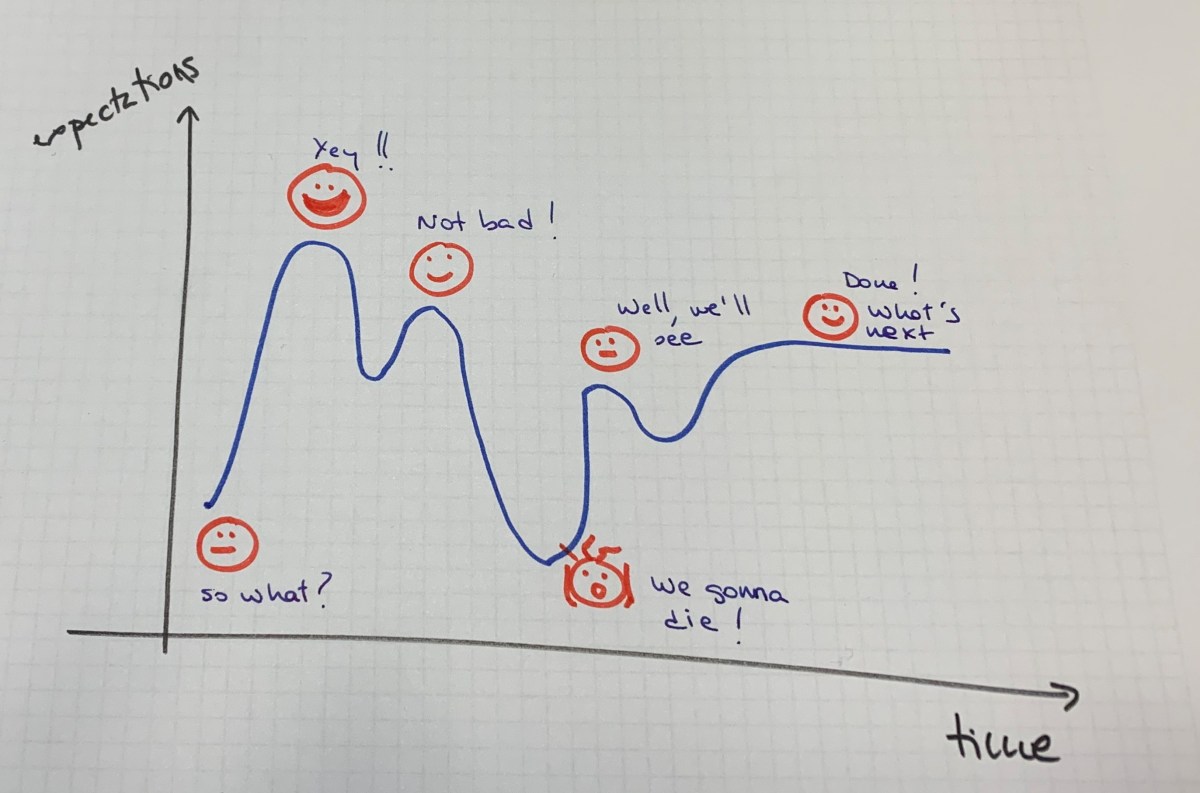
These last weeks I have rediscovered mines. Projects and adventures, have driven me through this kind of rollercoaster. Many people has drawn similar curves. This is my personal view of fun, mistery and effort.

Uncertainity can make the peaks bigger or smaller but each of us, individuals, teams, … go through similar phases. If you like starting from scratch, moving in a chaotic environment, embracing uncertainty.. you might well feel these phases.

These days are days of rapid changes, volatility… shorter cycles of ups and downs. You will, eventually, get used to it and how to lead with them.

Create, release, ask for feedback

Many of the things we build, create are for consumption by others. We suffer and enjoy the process, as we are creating something we feel it will be useful or special.

After, we share it, we sell it, we expose it. We are quite sure they will like it, after all that we include.

Feeback might come by itself as a review or we may ask for it. Was it useful? Would you change anything of the process to make it better?

We need to be prepared as it can be surprising, or not as good as we expected. And then, think if it helps to improve our product or it’s just something we should let go.

The important piece here is not lose the passion we felt when creating, keep being passionate about the building process. It’s the part where we can influence. The rest should only matters if it makes what we do a better thing.

What when the idea isn’t as good as we thought?

We are by nature ideas-generating machines. In a day we can ask and answer to ourselves so many times.. What if I did, try? And could I go home using a different route? Why don’t we? Hummm… what would happen if…?

As easy as they flow in our minds wwe let them go when we do not put them into practice.

From time to time, we have THE idea, and we decide to turn the picture we draw in our minds into something real, tangible. We start drawing how it will look like, to think of what we need, key milestones, resources, … Step after step. We give our time, effort, enthusiasm, hope, … All along this journey we are learning, upskilling, evolving. But we don’t realise we are.

Then, we achieve what we thought was our destination, our goal. And after a time of happiness and calm, discomfort shows up, we don’t get the results we expected. We realise it is not working. After all the excellent work, it’s not useful, it’s not the game changer we believed would be.

Nobody likes to be wrong, and so we insist, pushing forward, denying the obvious. To continue in the wrong road is exhausting and frustrating.

Admitting failure is brave. As it is to start again from scratch and to get advice from friends&experts.

Failure is not nice. Denial is fatal.

Yeah, we fail but we learn from it and move on. Better.

Learning to listen and to speak

There are few people who have the skills of true listening as also to know when and how to speak. These are two awesome «super powers».

It’s not easy to hear an opinion contrary to ours, without giving that look, or trying to rebate it just pursuing to be wright, to tell what is our position (even if the other person didn’t ask for it)

It’s not easy to listen, understand where is the comment coming from, without speaking right after the other one finishes the sentence.

It’s not easy to elaborate your speech in an open/dynamic debate.

It’s not easy to speak freely when you know there can be repraisals.

It’s not easy to speak on behalf of others (or maybe it’s too easy) when you think they are not free enough to do so.

It’s not a simple thing to do, in the heat of the discussion, to stay calm and rephrase our thoughts, when all we want to do is say out loud: I don’t agree with you.

It’s not easy to stay quiet when your opinion dissents 100% but you shouldn’t be expressing any opinion at all.

It’s not easy (When disagreeing) to build positively from where the other person ended.

It’s easy to just let out what we are keeping inside (no filtrers).

It’s easy to just wait for the other to finish his sentence so you can start with yours.

It’s easy to take as a personal offense hearing something we think we dislike but we do.

It’s easy not to speak so you won’t get in danger.

It’s easy to wait for that always someone else to stand up for you.


It is a very difficult job to listen instead of hearing. But it is also, difficult to remain silent when there is nothing to be said (Valuable), and to speak when and how we need to do so. Not everyone can do that, but we all can learn, practice makes perfect. It’s worth trying.

Stories

We all enjoy a good story. I like far more when it comes from a teller who captivates the audience. And it’s an every day situation.

  • The ones we read to our kids, written by someone else. The ones we transmit (as someone else did tell us to do so) but we don’t believe in.
  • The ones we make up for our kids, so to explain them the reality. The stories we elaborate and tell to others, hoping they’ll believe in the reality we are trying to build or hoping that will help non experts to understand what we are talking about or why this is our goal.
  • The ones we repeat to our kids again and again, so they see the world as we want them to see it. The ones we tell to ourselves, hoping they’ll become true, in front of the mirror every morning.
  • The ones we are told by the media, politicians, … that who knows if they are 100% real or not.
  • The ones we hear that we know they are not true (of which we are probably a character), and we will have to deny.

Doesn’t matter what type you are writing, telling or hearing. Everyone recognizes a good story. And an important element of that is WHO is the teller and HOW he/she tells the story. There  always somewhere an audience waiting for it.

Give me the space and the sky will be my limit

I ‘ve heard that there are creative and logical people.  But both have in common that when allowed to build something new, they come up with brilliant ideas. Ideas that, maybe, for years they have been thinking about but no one could hear them, that were triggered by a comment during an informal conversation, that ….

Want new things? Want to transform your team? Try opening a window, just to get some fresh air, letting people speak up, allowing ideas to flow freely, soon what they will open is a door.

Don’t let any judgment call come in, leave the group develop by itself, build from an old idea. Who knows? Anything can happen. The most tiny, microscopic idea can grow exponentially in a very short period of time.

Give them the tools to include news ways of doing, of thinking. The rest will come up by itself.

Logical or creative, we all have a lot to say, and when we are willing to change and develop, we are given the space to do so, the confidence, the freedom we encounter the «best of us».

Let them build their own future.

Networks: the strength of weak ties

After looking at the strong pieces, we will explore the weak ties, how powerful they are, what we need to do in order to have an excellent network.

Definition: invisible bonds that provide people with access to information and resources beyond those available in their own social circles. They provide the bridges where innovation cross boundaries.

Also identifiable as: that people we met at events, in a meeting that gathered together many people with similar interests. We keep in touch.

Relationship between nodes: acquaintances. That’s why their creation and maintainance require time.

Likely to find in them: High level of new information, possibilities or new opportunities.

If we go one step beyond our personal circles and we look at the organizational networks, we will find that if we want to stay in the current status quo we will stay close to our strong ties. They will reinforce our believes, but we won’t have the opportunity to discover what’s new out there, there will be little room for change. Organizations will work under a silos structure. Instead of that, weak ties, helps organizations to spread knowledge as they help in creating cooperation and coordination. They will break down silos.

So, if they are so benefitial, why we don’t use them more? They push ourselves out of our comfort zones. Firstly, because it’s required to meet new people so to start building them. Secondly, they require time but also mind openness to listen and interiorize different ways of doing or thinking. Finally because we have to overcome the convenience of our strong ties in case of urgency.

Now, do you frequently  find yourself complaining about things not changing? How willing are you to meet new people? Are you ready to keep the effort of avoiding our strong ties in case of help? To jump to ask an acquaitance instead of your close friends?


We have been out for a week. This time out was worthy. Battery full for what’s to come.


Networks: Strong and weak ties

In the next two posts we will look at two different types of network connections, strong and weak ties. Just an overview at their main characteristics, strengths and weaknesses.

Let’s start by the ones that might appear as more powerful, useful. The strong ones.

Definition: invisible bonds that make us feel a sense of belonging. The more stronger the tie connecting two individuals, the more similar they are.

Also identifiable as: Community, cluster, team.

Relationship between nodes: socially involved (Friends), family.

Likely to find in them: Low level of new information, possibilities or new opportunities. Overlap of between the info handled by two nodes with strong ties.

Easy way to «use» them: in search for support, the need to reinforce our opinion, thoughts or decisions.

It’s important to have strong ties, but they can not be the only ones to have. What happens when we look for a change, for a different approach?

Will the strong ties have the tools to help us?

Having a lot of strong nodes, does not guarantee success. It can be a lot of the same, if we always go around with the same people, who are friend, who get along with each other, what changes can there be for us? In all likelihood, very few.

When you look for a change to who do you go first? Do you get the results you expect? Yes, no, don’t know?

To help you with that we should explore the power of weak ties. And after that, look at our own connection network to see what distribution we have between strong and weak ties.


Note: based on the lecture of Granovetter 1983 («The Strength of Weak Ties: A Network Theory Revisited»).

Thanks Luis for sharing with me amazing food for thought.
New times for construction kits

Imagine a construction kit of 100 pieces, 1 set of instructions for 5 predefined figures and one single player, yourself. Pretty sure that mostly all of us has had one of this during his life. If you think about it, I am sure you find different behaviors when you observe kids nowadays sharing this toy.

There could be that kind of kid that played alone many times, followed the instructions that came with the toy and and perfectioned the figures to build.  But also, there is that one that didn’t even look at the instructions and just started building.

What happens when we add another player? A younger brother, a neighbour, another friend? Will they still follow the paper piece, will the owner of the game tell the others what to build next and how? Or will they just add more imagination to the game and assemble something different and amazing? Will they decide at the beginning what to build and discuss from time to time, what would happen if they did it that way? Giving the best of each?

When they will grow up, they’ll find a world constantly changing (faster than before), where usually the construction pieces do not come with instructions. And, they will have to get together with other kids who had their own toys and friends.

What do you want them to decide? Play by themselves, play with other kids (expanding their horizons)?

Will you wnat them to follow the instructions, always, as you did? Or will you want themto think out of the box and create something cool?

Will you want them to follow the owner’ orders (well, instructions) or will you prefer to see that each kid gives his best? That there is a debate of how to reach the common goal set before the game started?

The rules have changed, and in this case, what applies to kids applies to us. If you were the one who played alone, gave the orders or follow the instructions, it will be kind of difficult to change and adapt. To take risks. There are new «no rules». Adapt or …. live in the «always have been like that».

What we are, who we are

There is the story of that guy who was a Top Manager at a very important company. When he had to give a speech, he traveled business-class, stayed at the best hotels and didn’t pay for a single meal.  The time for him to step down, finally arrived. But he still was giving some speeches. But, instead of business trips, high standard hotels, expensive gifts… he had to travel tourist-class, … and what he got after the speech was a mug.

There is also the story of that other one, whose phone never stop ringing, first raw in the important events, all doors opened, all favours asked where done. When he stepped down his phone stop ringin, and when he made the call, there was no answer, no favors done.

Well, teaching here! what you are, goes away, usually with the job and most important the title you holded. Once you are no longer the person who represented a company, you get a mug.

When it comes to the who, it is about how you treated the people that surrounded you, where you nice with them? Did you help when being asked? Teached them? Learned from any of them? The things you take and you leave behind are the important ones, they build the «who». What are you made of. What got you there. And, regardless if you quit, retire, or whatever happens to you that is who you truely are. You will adapt to tourist-class, there will be no issue in paying your own meals…

When you call for help you have more probabilities to get an answer because of WHO you are rather than for WHAT you were.

Never lose sight of what is behind that fancy job name you hold.